

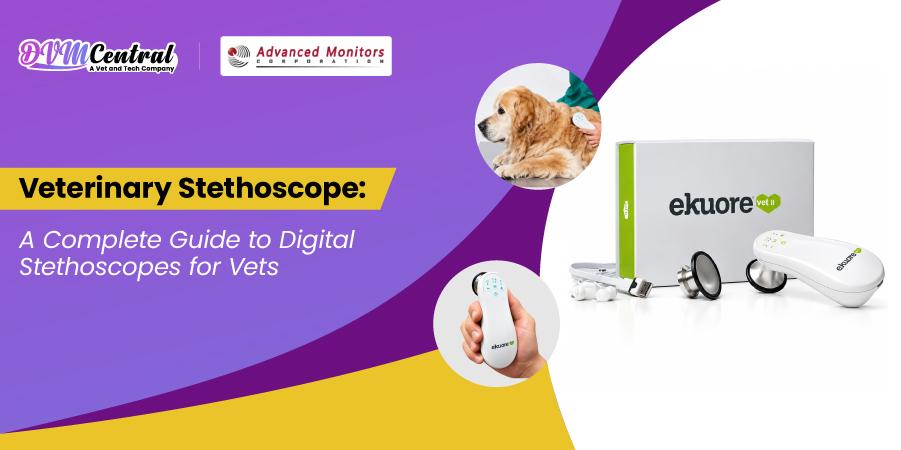
Veterinary Stethoscope: A Complete Guide to Digital Stethoscopes for Vets

A stethoscope is a medical instrument used to listen to sounds inside the body, including the heart, lungs, and digestive system. For decades, it’s been a standard part of physical exams so health professionals are able to listen for changes in these sounds that may warrant further attention.
Traditional stethoscopes have a chest piece, a tube, and earpieces that transmit sounds from the body to the listener. The newer digital and electronic models go a step further and amplify sounds, reduce background noise, record auscultations and share recordings with other devices.
This guide covers the basics of auscultation and the stethoscope. It also looks at digital and electronic stethoscopes and what they offer veterinary professionals.
What Is a Veterinary Stethoscope?
A veterinary stethoscope is a diagnostic device used to hear internal body sounds of animals. It works much the same as a human medical stethoscope, but the chest piece and tubing may be different or sized differently to better accommodate fur and different body shapes and the range of patient sizes that vets see in a day.
It is also called an animal stethoscope, since the same basic tool is used across species, from cats and dogs to horses, livestock, and exotic animals.
How Do Vets Perform Auscultation?
Veterinary auscultation is the act of listening to internal body sounds with a stethoscope to assess how well the body is functioning. A standard stethoscope’s chest piece picks up vibrations from organs and transmits the sounds through tubing to the veterinarian’s ears. A digital stethoscope sends sound to a speaker, app or recording.
During a routine exam, the veterinarian will move the chest piece to different parts of the chest and abdomen and listen for:
- Heart rate and rhythm
- Lung sounds such as crackles and wheezes
- Gut motility and other gastrointestinal sounds
Where the chest piece is placed matters too. For example, a small animal may need more precise placement to pick up heart and lung sounds, while a larger animal may require a different position or chest piece size. The type of patient and the sounds vets need to hear can guide their choice of an animal stethoscope.
What Type of Stethoscope Do Veterinarians Use?
Veterinarians either pick an acoustic or a digital stethoscope. The choice mainly depends on the practice’s budget, caseload, and how much detail the veterinarian wants from auscultation.
-
Acoustic Stethoscopes
Acoustic stethoscopes are non-electronic models, typically having a chest piece and headset with a tube connecting them both. The chest piece picks up the sound and transmits to the earpieces via tubes.
Acoustic stethoscopes are affordable, need very little maintenance, and are well suited to the pace of a busy clinic. DVM Central Vet Stethoscope 32 is an example of this traditional design.
-
Digital Stethoscopes
A digital veterinary stethoscope uses electronic amplification of sound. It has features like wireless communication and noise filtration in addition to using electronic sound amplification.
While wireless variants can transmit audio to a phone, tablet, or speaker via Bluetooth, certain electronic stethoscopes for veterinarians can be connected to headphones. This makes it easier for veterinarians to hear and record lung and heart sounds.
A Comparison of Digital vs. Acoustic Stethoscopes
Here is a complete comparison of digital vs. acoustic veterinary stethoscopes for better understanding.
|
Feature |
Acoustic Stethoscope |
Digital or Electronic Stethoscope |
|
Sound transmission |
Uses acoustic sound through tubing |
Converts sounds into digital signals |
|
Amplification |
Relies on natural acoustic transmission |
Electronic amplification can make faint sounds easier to hear |
|
Noise reduction |
Limited |
May include noise filtering |
|
Recording |
Not available |
Can record and save auscultations on supported models |
|
Playback |
Not available |
Allows recorded sounds to be reviewed later |
|
Sharing |
Not available |
Some models can share recordings through connected devices |
|
Power |
No battery or charging needed |
Requires a battery or power source |
|
Cost |
Generally more affordable |
Usually costs more |
|
Best suited for |
Routine exams and general practice |
Detailed review, teaching, telemedicine, and documented recordings |
Many practices may find value in having both. An acoustic model works well for quick daily exams, while a digital device gives veterinarians another option when a case calls for closer review or a recording that can be shared.
What Are the Advantages of a Digital Veterinary Stethoscope?
The major benefit of a digital stethoscope is making murmur sounds easier to hear, as well as the ability to record, share and review auscultations later. These features may be useful in patient assessment, client discussions, and veterinary education.
Specific advantages of digital veterinary stethoscope include:
- Stronger amplification. An amplified stethoscope can assist you in hearing weak heart murmurs and subtle lung sounds more easily than a regular acoustic stethoscope could.
- Noise filtering. Internal heart and lung filters can cut down on background noise, which is beneficial in a busy clinic or a noisy exam room.
- Recording and playback. Auscultations and phonograms can be recorded for subsequent examinations. Vets can save and share them as patient record with a specialist when another opinion is needed.
- Accessibility. Digital veterinary stethoscopes can connect to headphones or earbuds. This makes auscultation easier for veterinarians with hearing difficulties.
- Wireless listening. A wireless veterinary stethoscope with a distant probe can provide the veterinarian with more freedom to listen without hovering right over a nervous or difficult patient.
- Client education. Letting pet owners hear their animal’s heartbeat or see a phonogram can make it easier to explain what you found during the exam.
- Teaching value. Veterinary students and new technicians can listen to the same sounds as a supervisor in real time, giving them more opportunities to learn auscultation skills in practice.
A Reliable Veterinary Digital Stethoscope for Vets:
For practices looking to switch from a traditional model to a digital device, the eKuore digital stethoscope is worth considering. The eKuore Vet II offers amplification of up to 20 times compared with standard acoustic stethoscopes.
What makes this veterinary electronic stethoscope useful is that it goes beyond simply making sounds louder. Veterinarians can record heart and lung sounds along with the corresponding phonogram and then review those recordings later.
Key eKuore Vet II Features
|
Feature |
What it offers |
|
Up to 20x amplification |
Makes auscultation sounds louder and easier to hear. |
|
Wireless audio |
Sends sound to smart devices, speakers, and earplugs of headphones. |
|
Heart and lung recording |
Records sounds for later review. |
|
Phonogram recording |
Records the phonogram along with the audio. |
|
Patient record storage |
Keeps recordings with the patient history. |
|
Specialist sharing |
Lets you share recordings with another veterinarian for review. |
|
Adjustable volume |
Lets you adjust sound when using compatible earplugs or headphones. |
Looking for the Right Veterinary Stethoscope?
An acoustic stethoscope can work well for routine exams, but digital models offer more options for recording, reviewing, and sharing auscultation sounds. DVM Central offers the eKuore digital stethoscope for veterinary teams looking for these added capabilities, along with acoustic options such as the Vet Stethoscope 32. Compare the available stethoscopes to find the right fit for your practice.
Summary
A veterinary stethoscope remains a go-to tool for everyday exams, but today’s options go beyond the traditional acoustic model. Acoustic stethoscopes are still a practical choice for routine work, while a digital veterinary stethoscope like eKuore adds features such as sound amplification, recording, and wireless listening.
Looking for more than a traditional stethoscope?
The eKuore digital stethoscope adds features such as sound amplification, recording, and playback to everyday veterinary exams. You can find the eKuore veterinary stethoscope at DVM Central.
FAQs
What is a veterinary stethoscope used for?
A veterinary stethoscope is used to listen to an animal's heart, lungs, and gastrointestinal tract during exams, helping vets detect murmurs, abnormal breathing sounds, and changes in gut motility.
What is the best stethoscope for veterinary doctors?
The best stethoscope depends on the type of practice, and the way you use it. If you want features like sound amplification, recording, and wireless connectivity, the eKuore digital stethoscope is a good option made for veterinary use.
How much does a digital veterinary stethoscope cost?
The price of a digital veterinary stethoscope varies by brand and features. You can buy the eKuore veterinary stethoscope from DVM Central for $950.
Is there a difference between a human stethoscope and a veterinary stethoscope?
Yes. A veterinary stethoscope is designed with the needs of animal patients in mind, including differences in body size, anatomy, and coat. Human stethoscopes can also be used on animals, but veterinary models offer features and chest piece options better suited to different species and patient sizes.
What is the difference between an acoustic and a digital veterinary stethoscope?
An acoustic stethoscope transmits sound purely through tubing with no electronics involved, while a digital stethoscope amplifies sound electronically and can often record, filter, and share audio through an app or speaker.
What is the difference between eKuore or Littman CORE stethoscopes?
The main difference between Littmann CORE digital and eKuore stethoscopes is that the Littmann CORE is used in human medicine, whereas eKuore is designed for use in veterinary medicine.


DVM Central is the trusted veterinary marketplace connecting suppliers, veterinarians, and pet owners, promoting direct buying for quality animal health products, and simplifying veterinary supply transactions.
%20Blog%20-%20Discover%20Thermotex%20Therapy%20Systems-thumbnail-1789135670.jpg&w=3840&q=75)