


Advanced Monitors Corporation on DVM Central: Laser Technology for Veterinary Care
Contents
- What is Veterinary Laser Therapy?
- How Does Laser Therapy Work?
- Therapeutic Laser vs. Surgical Laser
- Benefits of Laser Therapy in a Veterinary Practice
- AMC Small Animal Diode Surgical/Therapy Laser on DVM Central
- Advanced Monitors Corporation Products on DVM Central
- Practical Considerations When Choosing Veterinary Laser Equipment
- Final Thoughts
- FAQs

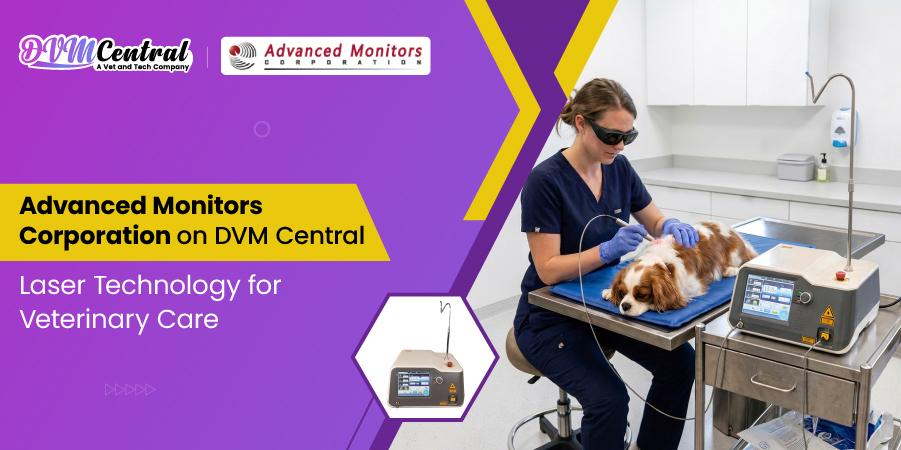
Laser technology has become a routine part of modern small animal practice. From cutting soft tissue with less bleeding to supporting comfort and recovery in a rehabilitation plan, veterinary laser equipment now covers a wide range of clinical needs. For many clinics, the question is no longer whether to add a laser, but which type fits the caseload, the team, and the budget.
Advanced Monitors Corporation (AMC) manufactures veterinary equipment, including diagnostic and endoscopy devices, the eKuore Digital Stethoscope, and the AMC Diode Surgical/Therapy Laser. Available through the AMC product listing on DVM Central, these products serve a range of veterinary needs.
This guide looks at how veterinary laser therapy works, its uses in dogs and cats, and the differences between therapeutic and surgical lasers. It also takes a closer look at the AMC Small Animal Diode Surgical/Therapy Laser, including its listed features and intended uses.
What is Veterinary Laser Therapy?
"Laser" stands for "light amplification by stimulated emission of radiation," and veterinary medicine uses it in many ways.
- Therapeutic lasers deliver controlled light energy to tissue to promote healing and provide comfort. This is usually referred to as photobiomodulation or low-level laser therapy.
- Surgical lasers deliver a focused amount of energy to cut, vaporize, or coagulate soft tissue.
These two categories are very much the same in terms of engineering. A diode laser, for instance, uses a semiconductor to generate the light, and the fundamental technology is the same in both cases. What changes is the beam, the power, the technique, and the clinical goal. Understanding that difference is the first step in choosing the right veterinary laser equipment for a practice.
How Does Laser Therapy Work?
To understand how laser therapy works, it helps to look at how light interacts with cells and triggers biological responses within the body.
When red or near-infrared light reaches the tissue, certain molecules within the cells absorb the light energy. One of the main photoacceptors involved is cytochrome c oxidase, an enzyme found in the mitochondria, the parts of cells responsible for producing energy.
Light absorption may influence mitochondrial activity and ATP (adenosine triphosphate) production. It can also affect inflammatory pathways, tissue repair, and the way the body processes pain signals. Unlike surgical lasers, therapeutic lasers are designed to stimulate cellular responses rather than cut or remove tissue. However, higher energy levels can still produce heat.
Dose matters as much as power.
In laser therapy, the dose, also called energy density or fluence, refers to the amount of energy delivered per unit of treatment area. It is measured in joules per square centimeter (J/cm²).
A lower-power laser may take longer to deliver a given amount of energy, while a higher-power laser can deliver it in less time. However, the biological response also depends on how quickly the energy is delivered, so the same dose does not always produce the same effect.
Several factors influence treatment protocols, including wavelength, power density, treatment time, coat color, skin pigmentation, and the depth of the target tissue. Understanding these parameters and applying the right technique are key parts of laser therapy.
Therapeutic Laser vs. Surgical Laser
The terms are sometimes used loosely, so a side-by-side comparison helps clarify how each type is used.
|
Feature |
Therapeutic Laser |
Surgical Laser |
|
Main purpose |
Photobiomodulation to support comfort, inflammation control, and tissue healing |
Cutting, vaporizing, and coagulating soft tissue |
|
Tissue effect |
Photochemical, with no intended thermal damage |
Photothermal, with intentional tissue heating |
|
Beam |
Often defocused or scanned across a treatment area |
Focused and narrow for precise work |
|
Typical use |
Arthritis, wounds, postoperative recovery, rehabilitation |
Soft tissue surgery, masses, polyps, oral procedures, laparoscopic or endoscopic work |
|
Key variable |
Dose, meaning total energy delivered |
Power control and technique |
|
Operator focus |
Treatment time, area, and protocol |
Tip preparation, power setting, and tissue handling |
As surgical and therapeutic lasers are based on the same technology, some diode systems are designed to do both. That's the concept behind the AMC product we're looking at.
Benefits of Laser Therapy in a Veterinary Practice
When used appropriately, the benefits of laser therapy for a practice and its patients can include:
- A noninvasive treatment option that most patients tolerate well
- A drug-sparing option within a multimodal pain plan
- Support for postoperative and wound care protocols
- A service that can expand rehabilitation and senior care offerings
- Short treatment sessions that fit into a busy appointment schedule
It's important to be realistic about expectations. The evidence base is actually quite variable from indication to indication; results will vary from patient to patient, and we need to be very careful in our communication with owners to reflect that.
AMC Small Animal Diode Surgical/Therapy Laser on DVM Central
The AMC Small Animal Diode Surgical/Therapy Laser is a dual-purpose system. It can be used for both soft tissue surgery and laser therapy at approximately the same cost as a dedicated therapy laser.
Key Features
- 30 watts of power. The listing notes this is well above the 10 to 20 watts typical of most standalone therapy lasers, which it says lack the power needed for true surgical use.
- Surgical capability. The laser handles general soft tissue surgery as well as laparoscopic and endoscopic procedures.
- Therapy capability. The same unit supports standard laser therapy treatments.
- Dual purpose value. A practice can cover surgery and therapy with one device rather than purchasing two.
- Established manufacturer. Advanced Monitors Corporation is described as an established veterinary equipment manufacturer.
Who May Benefit Most
This type of system may suit a general or referral practice that performs regular soft tissue procedures and also wants to offer therapy for arthritis, wounds, or recovery support. A surgeon who already uses a separate surgical diode laser, or a clinic that wants a dedicated therapy platform with a specific wavelength and handpiece set, may want to compare options more closely.
Advanced Monitors Corporation Products on DVM Central
The laser is one of a range of products. The Advanced Monitors Corporation on DVM Central lists 11 products in the area of laser technology, endoscopy, airway scopes, auscultation, and monitors. It's a manufacturer that is clearly focused on diagnostic and procedural tools for small animal, exotic, and referral practices. Here’s a glimpse of all AMC products on DVM Central.
|
Product |
Category |
Key details from the listing |
|
Surgical and therapy laser |
30 watts, dual-purpose, general soft tissue surgery plus laparoscopic and endoscopic procedures and therapy treatments |
|
|
Laparoscopy or arthroscopy |
Laparoscope for minimally invasive procedures; confirm length, diameter, and light source with AMC |
|
|
Endoscopy accessory |
Camera that connects to a scope ocular for live image display on a computer screen, as described on AMC scope listings |
|
|
Rhinoscopy |
1.67 mm diameter, 10,000 fiber image bundle, 10- and 20-inch lengths, waterproof insertion tube, 200-lumen LED light source, battery-powered handle |
|
|
Airway and exotic care |
Guides ET tube placement in rabbits and small animals; also used for rhinoscopy, otoscopy, and cystoscopy; rechargeable light handle with charging base |
|
|
Bronchoscopy |
65 cm length, 2.6 mm working channel, 2-way articulating control body, 3.5-inch recording camera, USB or SD card download, hard-sided case |
|
|
Bronchoscopy |
65 cm length and a narrower 3.9 mm diameter than the 5.8 mm model |
|
|
Auscultation |
Digital stethoscope designed for animal use, with recording and sharing through an app |
|
|
Monitor |
4.3-inch monitor described as offering the functionality of larger, more expensive monitors |
|
|
Monitor |
10.4-inch display listed under monitors on DVM Central |
|
|
Monitor |
12.1-inch display listed under monitors on DVM Central |
Practical Considerations When Choosing Veterinary Laser Equipment
A laser is a clinical tool, a safety responsibility, and a business investment, so it helps to look beyond the spec sheet.
- Caseload. Estimate how many surgical and therapy cases the clinic sees each month to judge whether a dual-purpose system makes sense.
- Training. Therapy dose calculation and surgical technique both require proper training. Ask what onboarding and ongoing support the manufacturer offers.
- Safety. Laser use requires protective eyewear rated for the device wavelength for the team and the patient, controlled access to the treatment area, and clear written protocols.
- Workflow. Consider handpiece options, setup time, and how easily the system moves between a surgery suite and a treatment room.
- Client communication. Explain what the treatment can and cannot do, how many sessions are typical, and how it fits into the overall plan.
- Support and service. Ask about warranty terms, maintenance, and replacement parts before purchase.
Final Thoughts
Veterinary laser therapy is clearly on the rise as a viable option for both surgical and rehabilitation care in dogs and cats. The best results come from matching the right laser to the right clinical need, ensuring the team is properly trained, and managing owners' expectations realistically. For practices considering a dual-purpose system, the AMC Small Animal Diode Surgical/Therapy Laser is a 30W unit with both surgical and therapy capabilities in one device.
To review the full product range with prices, visit the Advanced Monitors Corporation listing on DVM Central.
FAQs
What is veterinary laser therapy used for?
Veterinary laser therapy is used to support the healing process and to provide pain relief in pets with osteoarthritis, wounds, post-op injuries, and soft tissue conditions. Surgical lasers are a completely different beast and are used for cutting and/or ablation of soft tissue.
Is laser therapy for cats and dogs safe?
Yes, therapeutic laser therapy is generally well tolerated when it's being administered by trained personnel using the correct settings. The main precautions are to use protective eyewear, not to look directly into the beam, and to follow the manufacturer's safety instructions.
Does laser therapy for arthritis in dogs work?
Yes, some studies report reduced pain, better mobility, and lower NSAID requirements in dogs with osteoarthritis. However, research findings vary, and laser therapy is best included as part of a broader arthritis management plan.
How many laser therapy sessions does a pet need?
The number of sessions will vary according to the condition, how long it's been going on, and the treatment protocol. For a chronic condition like arthritis, you'd probably have an initial series of sessions followed by a series of maintenance sessions.
What is the difference between a therapeutic laser and a surgical laser?
A therapeutic laser delivers light energy to promote tissue healing; a surgical laser delivers light energy to cut, ablate, or coagulate tissue. Some diode systems have both capabilities in one unit.
Can the AMC Small Animal Diode Surgical/Therapy Laser be used on both dogs and cats?
Yes, the DVM Central listing describes it as a small-animal laser system for soft-tissue surgery and therapy. Clinics should confirm species-specific protocols, treatment settings, and training requirements with Advanced Monitors Corporation.


DVM Central is the trusted veterinary marketplace connecting suppliers, veterinarians, and pet owners, promoting direct buying for quality animal health products, and simplifying veterinary supply transactions.


