


Need Advice?
+1(407) 881-2002
Need help?

Payment Method


Secure Express Checkout
Save your payment information securelystripefor express checkout.
Product Description
Your team needs reps. There's nowhere to get them.
Dental radiography is a physical skill. You don't learn it from a video at midnight, and you don't learn it from notes you took at a one-day course. You learn it by doing it enough times that the sensor goes where it needs to go without you thinking about it.
The problem is where those reps come from. There are three places, and every one of them runs out.
A dry skull. No tongue, no larynx, no ET tube, no soft tissue in the way. The obstacles that make a real dental radiograph difficult are exactly the parts that aren't there. And when it comes apart mid-session, you're rebuilding it instead of teaching.
A cadaver. Closer to the real thing, and there's a reason the pathway exists. But it arrives already compromised, it isn't the one you had last month, and it's finite. You can't hand it to a delegate and say "now do that forty more times." Sourcing, storage and disposal cost you before the session starts.
A live patient. The only place left. Under anesthesia, clock running, someone's pet on the table, and the learning happening at the patient's expense.
These models don't run out. Same anatomy, same tissue, same obstacles, every session, for as many reps as anyone needs.
What's in the kit
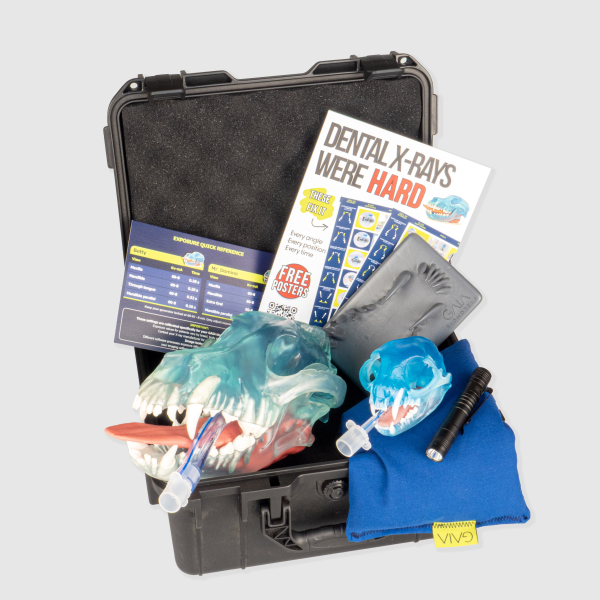
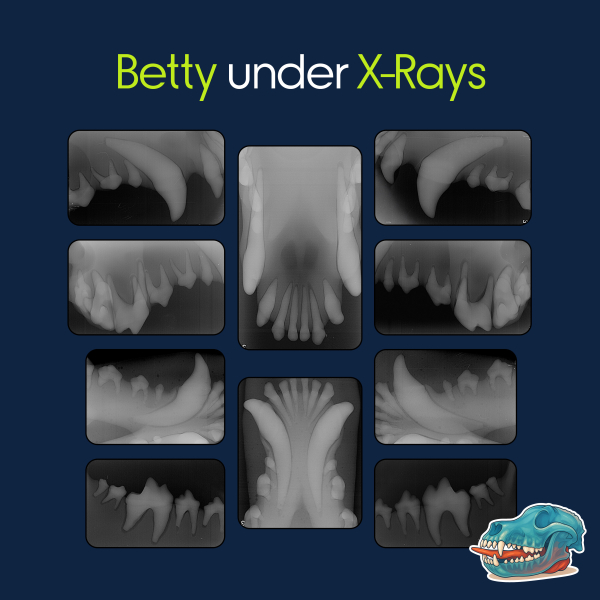
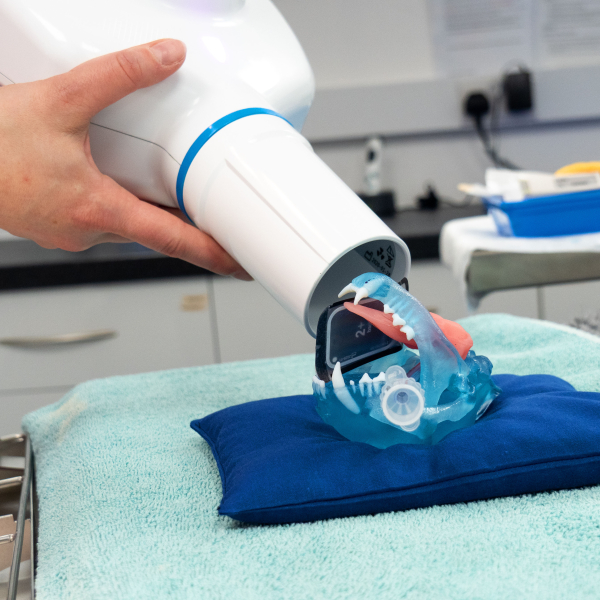
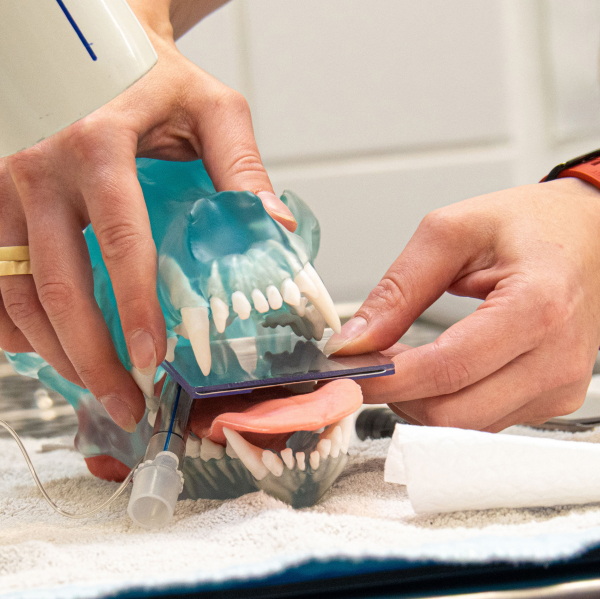
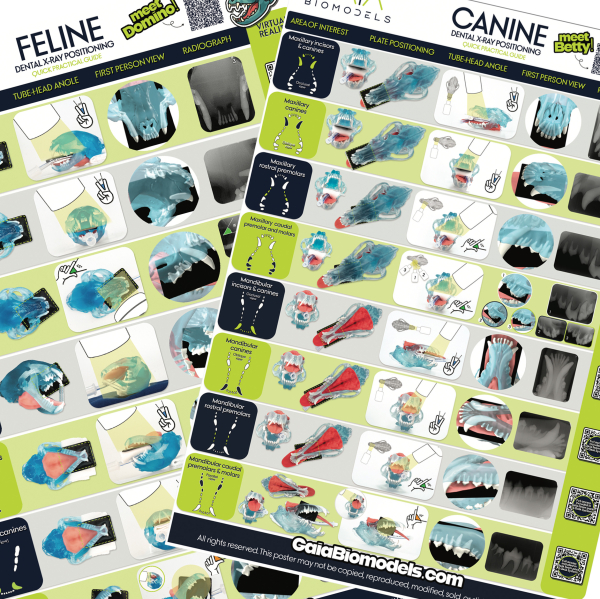
- Betty, the canine model. Articulated, radiopaque skull with soft-tissue overlays. Tongue, larynx, ET tube simulation. The obstacles you fight on a real patient are the obstacles you practice against here.
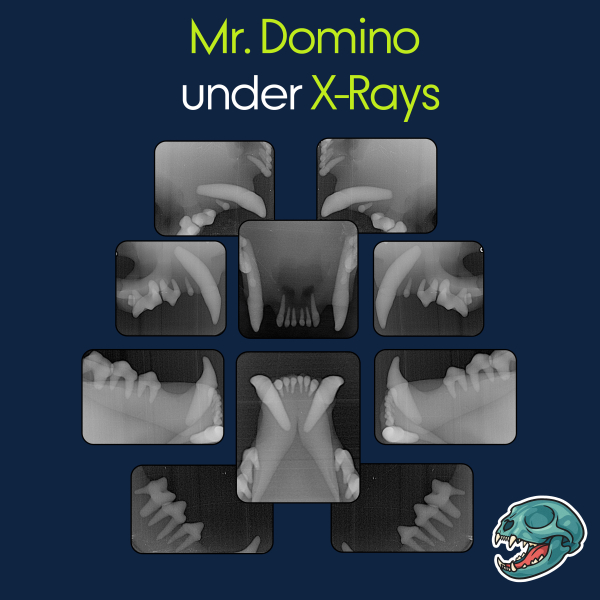
- Mr. Domino, the feline model. Built for the angles cats make difficult. Every view, on the bench, as many times as you want.
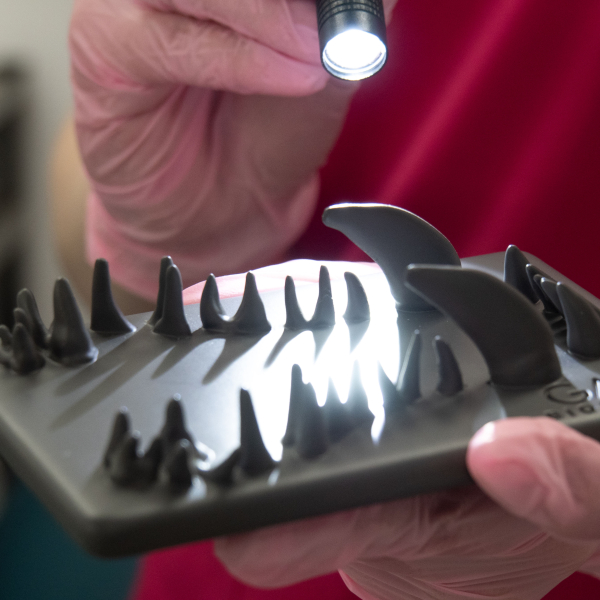
- Shadow Monster, the bisecting angle trainer. Comes with a positioning torch. Cast the shadow, see the angle. The thing that takes an hour to explain at a whiteboard becomes obvious in about ten seconds.
- Professional transport case. For teaching centers and anyone moving the kit between sites.
Works with the equipment you already own
Any X-ray unit. Handheld or wall-mounted generators. Phosphor plates or digital sensors, any size. Nothing to install and nothing to calibrate. Put the model on the table and shoot.
This is the simulation-before-patients approach human medical training has used for decades. Veterinary dentistry never had the tools for it. Now the mistakes happen on the bench: the cone cut, the elongated root, the sensor two millimeters off. Every one of them made in the one place where it costs nothing.
Built for teaching
Educators, CPD providers, teaching centers, and specialists who already know how to teach dental radiography and want better tools to teach it with.
Who makes them
GAIA Biomodels is a UK company founded by a practicing vet who watched patients pay the price for gaps in radiography education. Our models are used in 12 countries by first-opinion clinics, corporate veterinary groups, and vet schools.